Quick Navigation
- What is a pay per call affiliate network?
- How does pay per call work?
- What counts as a qualified call?
- How much do pay per call offers pay?
- The 10 best pay per call affiliate networks for 2026
- 1. Aragon Advertising
- 2. Marketcall
- 3. Service Direct
- 4. RingPartner
- 5. PALO (Astoria Company)
- 6. eLocal
- 7. Digital Market Media
- 8. ClickDealer
- 9. MaxBounty
- 10. Inquirly
- Network comparison
- The call-tracking platforms you'll actually use
- How to choose the right network
- How to get approved
- TCPA and compliance: what's true in 2026
- Best traffic sources for call offers
- Mistakes that kill call campaigns
- FAQ
Most affiliates fight over clicks their whole career.
They tune a landing page for weeks to lift a conversion rate half a percent, then collect a few dollars per sale. Meanwhile a quieter group of marketers gets paid $30, $80, sometimes $150 for one phone call. And they do it with less traffic.
That's the whole pitch for pay per call. Unlike a lot of affiliate hype, the math actually holds up.
A call is not a click. When someone dials a number about their leaking roof or their Medicare options, they're not browsing. They're ready to talk, and often ready to buy. Advertisers know it, so they pay far more for a qualified call than for a click or a form fill.
This guide is built to be the one page you need. You'll get how the model works, what a call is worth in each vertical, the ten networks worth joining, the tracking tools the pros use, and the compliance rules that shifted again in 2026 and still trip people up.
Let's get into it.
What is a pay per call affiliate network?
A pay per call affiliate network is a marketplace that connects you, the affiliate, with advertisers who pay for qualified inbound phone calls instead of clicks or online sales.

The network hands you a tracking phone number, sets the rules for what counts as a billable call, routes the call to the right buyer, and pays you when a call qualifies.
Think of it as the same middleman role a normal CPA network plays. The difference is the conversion. Here it's a phone call, not a link click.
Quick definition: Pay per call affiliate marketing is a performance model where affiliates earn a commission for driving qualified inbound phone calls to an advertiser. The conversion is a tracked call, usually validated by call duration, caller intent, and location, not a click.
A few terms you'll see throughout, defined once so nothing trips you up:
- CPA (Cost Per Action): the umbrella model where you're paid for an action. A call is one type of action.
- Qualified call: a call that meets the advertiser's minimum rules, usually a duration threshold plus caller fit.
- DNI (Dynamic Number Insertion): tech that shows a unique number to each visitor or source, so calls trace back to you.
- IVR (Interactive Voice Response): the "press 1 for service" menu that screens callers before a human answers.
- Ping-post: a real-time system where a call's details are "pinged" to buyers, who bid, and the call is "posted" to the winner.
How does pay per call work?
It looks complicated from the outside. It isn't. Five steps:
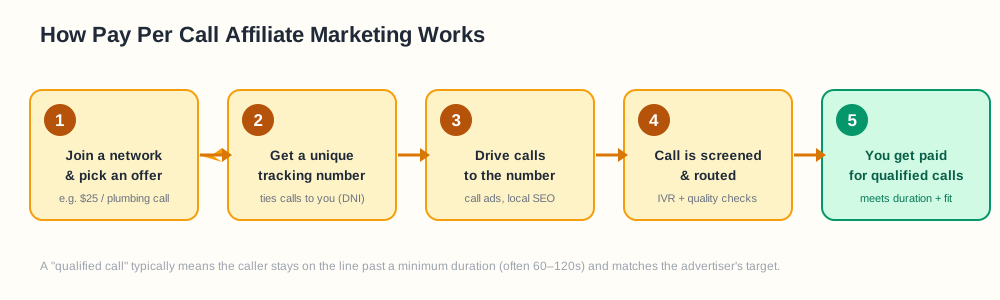
- Join a network and pick an offer. Say a home-services campaign paying $25 per qualified plumbing call in the US.
- Get your tracking number. The network assigns a number (or a DNI setup that rotates numbers) tied to your account and traffic source.
- Drive calls to it. Promote it through the channels the offer allows: Google call-only ads, a local SEO page, click-to-call buttons, native or push ads.
- The call is screened and routed. It passes through an IVR and the network's rules, which check intent, location, and timing before connecting the caller to the buyer.
- Get paid for calls that qualify. Meet the advertiser's rules, usually a minimum duration plus caller fit, and you earn.
The neat part: advertisers only pay for calls that turn into real conversations, and you earn far more per qualified call than per click.
The trade-off, and I'll be honest about this throughout, is that getting someone to dial takes more work than getting a click. The compliance stakes are higher too.
What counts as a qualified call?
This is the concept beginners have to internalize, because it's where the money is won or lost.
You are not paid for calls. You are paid for qualified calls.
Networks judge quality on a few things:
- Duration. The call has to run past a minimum billable length, commonly 60, 90, or 120 seconds. Hang-ups and wrong numbers don't bill.
- IVR screening. An automated menu confirms the caller actually wants the service before an agent picks up.
- Geographic and demographic fit. The caller has to match the target: right coverage area, right age band. Out-of-area calls get filtered out.
- Call caps. Buyers set daily or hourly caps on how many calls they'll take, so timing matters.
- Quality controls. Call recording, duplicate detection, and spam filtering sit in the background deciding whether your traffic is worth keeping.
Before you send a single call, ask your affiliate manager two things: "What's the minimum billable duration?" and "What are the daily caps?" Those two numbers shape your entire strategy.
How much do pay per call offers pay?
Payouts swing more in pay per call than in almost any other affiliate model. One qualified call can be worth a few dollars or a few hundred, depending on the vertical.
Here are current, source-backed ranges. Treat them as typical bands, not guarantees. Actual rates depend on the network, the season, and your call quality.
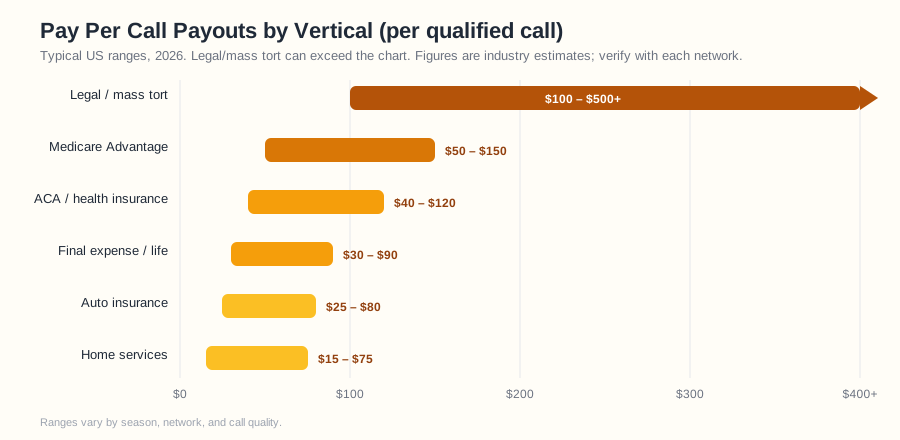
| Vertical | Payout per qualified call | Notes |
|---|---|---|
| Home services (HVAC, plumbing, roofing) | $15–$75 per qualified call | Beginner-friendly; varies by trade and urgency |
| Auto insurance | $25–$80 per qualified call | Non-standard / high-risk drivers reach $90–$150 |
| Final expense / life insurance | $30–$90 per qualified call | Steady year-round demand |
| ACA / health insurance | $40–$120 per qualified call | Higher during Open Enrollment |
| Medicare Advantage | $50–$150 per qualified call | Spikes during the Annual Enrollment Period |
| Legal / mass tort | $100–$500+ per qualified call | Among the highest-value calls in the industry |
Two things beginners get wrong here.
First, the eye-popping figures (a $1,700 legal lead) are cherry-picked from the top verticals and usually need call-center-grade traffic and airtight compliance. That's not what a new affiliate should expect.
Second, a high payout means nothing if your call quality is low. A $120 health call that never passes the duration threshold pays you exactly zero. Aim for the intersection of decent payout and realistic conversion, which for most beginners is home services.
The 10 best pay per call affiliate networks for 2026
Ranked by overall merit for a US and global audience: reputation, vertical strength, transparency, and beginner-to-intermediate fit. Where a network's terms aren't published, this guide says so instead of inventing a number. Each entry ends with an honest take, downsides included.
1. Aragon Advertising
Best for: experienced affiliates and call centers chasing premium verticals.
Aragon has topped the pay per call category in industry rankings for years and has run since around 2012. Its verticals span insurance, finance, home services, legal (including mass tort), and healthcare.
Payouts are per qualified call, often cited up to $100 and well beyond for top legal offers. Tracking runs on established call platforms; payments come via PayPal or wire on a weekly to semi-monthly Net-15 basis.
The honest take: the four-figure call figures come from mass tort and premium insurance, not from a beginner's first week. Those need real call infrastructure and strict compliance. Exact net terms aren't fully public, so confirm them with your manager before you scale.
2. Marketcall
Best for: beginners and intermediates who want transparency and fast pay.
Founded in 2015, Marketcall runs on in-house call tracking and covers insurance, finance, home services, and travel across the US and Europe. It shows you the payout before you promote, and it lets you listen to unconverted calls, which is genuinely useful for optimization.
Cited call payouts run roughly $15 to $100. The minimum payout is $100, paid weekly.
The honest take: per-call payouts here are lower than what a legal- or insurance-only specialist will offer. You're trading some upside for transparency, weekly cash flow, and a gentler learning curve. When you're starting out, that's a smart deal.
3. Service Direct
Best for: affiliates with local home-services traffic.
Service Direct has run for about 20 years and focuses on home services: HVAC, plumbing, electrical, roofing, water damage, locksmith, pest control, and more. Its leads are exclusive, so each call goes to a single buyer and you're not competing with five other affiliates to sell the same call.
You see the payout before you promote. Cited payouts run $10 to $900 depending on the trade, paid Net-15 by ACH. US-only.
The honest take: it's narrow by design, US-only and home-services-only. But if that's your lane, the exclusivity and payout transparency are hard to beat.
4. RingPartner
Best for: North American affiliates who want variety and fast pay.
RingPartner runs a real-time-bidding call exchange across home services, auto and life insurance, medical, legal, and appliance repair. It's known for low approval friction and quick payments, with per-lead payouts cited up to $80.
The honest take: reviews are mixed. Plenty of affiliates like the variety and speed; some report payout disputes. Start small, keep your own call records through a tracking platform, and confirm your calls are being counted before you scale spend.
5. PALO (Astoria Company)
Best for: affiliates with high-intent legal, insurance, and finance traffic.
PALO has specialized in inbound calls since 2010, and parent Astoria Company has run performance marketing since 2006. Verticals lean legal, healthcare, and finance, with roughly 200 pay per call offers. Payment is per call or ping-post, cited from a couple of dollars up to around $350 to $500 per lead, paid Net-15.
The honest take: the PALO/Astoria branding is confusing, and the network doesn't publish full terms. The track record is strong, but the vetting is rigorous, so it's not a network for raw beginners. Get the specifics in writing during onboarding.
6. eLocal
Best for: affiliates monetizing US local-service and call traffic.
eLocal has connected consumers with local providers since 2007, across home services, legal, insurance, medical, and automotive. It's known for quality filters and rewards experienced publishers who deliver consistent, high-intent traffic. Payouts are cited up to $200 per lead, paid weekly.
The honest take: it leans toward experienced publishers and US traffic. If you can deliver clean, high-intent local calls, the payouts and weekly cash flow are solid.
7. Digital Market Media
Best for: compliant affiliates with Medicare, health-insurance, or legal traffic.
Digital Market Media focuses on high-value healthcare and legal, with exclusive live-transfer campaigns cited up to $400 per call.
The honest take: premium payouts, premium risk. Medicare and health calls are among the most TCPA-sensitive verticals in the country (see the compliance section). Narrow vertical set, and you'll need clean, consented traffic. Don't start here.
8. ClickDealer
Best for: global media buyers running a mix of CPA and call campaigns.
ClickDealer is a global full-cycle network that has run pay per call since around 2014, carrying a huge inventory across 40+ verticals, including US home-services inbound offers. Models include CPA, CPL, CPS, RevShare, and pay per call.
The honest take: ClickDealer isn't call-first. Pay per call is one slice of a very broad catalog, and its call-specific terms aren't especially transparent up front. Great for global reach and mixed models in one place; less ideal if you want a pure specialist.
9. MaxBounty
Best for: generalist CPA affiliates who want some call offers alongside everything else.
MaxBounty has been a trusted, reliably-paying CPA network since 2004, with insurance, home-services, and financial call offers inside a huge broader catalog. Minimum payout is $100, paid weekly after a Net-15 first payment.
The honest take: pay per call is a side dish here, not the main course. The call-vertical depth doesn't match a dedicated network's. Good for reliability and one-dashboard convenience; not the place for serious, scaled call campaigns.
10. Inquirly
Best for: affiliates with insurance, legal, and home-services call traffic who want strong tech.
Inquirly is a newer, technology-driven network (around 7 years in) built on proprietary routing, with insurance, legal, home services, and financial verticals. It offers real-time analytics, personal account managers, and payouts cited up to $250 for high-intent legal and insurance calls, paid weekly.
The honest take: less of a public track record than the older names on this list, simply because it's younger. The tech and weekly pay are appealing; confirm terms and reputation during onboarding.
Network comparison
| Network | Best for | Verticals | Payout model | Payment | Geo |
|---|---|---|---|---|---|
| Aragon Advertising | experienced/premium | insurance, legal, home services | per call, tiered | weekly to Net-15 | global |
| Marketcall | transparency and beginners | insurance, finance, home services | per call, fixed | weekly | global |
| Service Direct | local home services | HVAC, plumbing, roofing | exclusive per call | Net-15 | US |
| RingPartner | fast pay and NA variety | home services, insurance, legal | RTB per call | fast | US/Canada |
| PALO / Astoria | legal, insurance, finance | — | per call and ping-post | Net-15 | US |
| eLocal | US local services | home, legal, insurance | rev share / per call | weekly | US |
| Digital Market Media | health, Medicare, legal | — | per call / live transfer | monthly (cited) | US |
| ClickDealer | global mixed CPA + call | 40+ verticals | multi-model | varies | global |
| MaxBounty | generalist CPA + calls | insurance, home, finance | CPA + per call | weekly | global |
| Inquirly | insurance, legal, home | — | per call and CPL | weekly | US |
Terms marked "cited" or left general should be confirmed directly with the network during onboarding.
The call-tracking platforms you'll actually use
Here's a distinction beginners miss constantly.
A network connects you to buyers. A tracking platform is the software that routes, records, and attributes your calls.

Some networks have their own tracking built in. Serious affiliates often run their own platform on top, so they control the call flow and can push calls to whoever bids highest. These are platforms, not networks. Don't confuse them:
- Ringba: the platform of choice for many pay per call affiliates. Its real-time bidding lets multiple buyers bid on your call live, so you capture the top rate instead of a flat network payout. Usage-based pricing.
- Retreaver: attribute-based call tracking and routing (tags, buyer rules, call caps).
- Invoca: enterprise call tracking with AI conversation analytics, aimed at large regulated advertisers more than solo affiliates.
- Phonexa: a full call-tracking and lead-management suite; its Call Logic ping-post engine powers several networks.
- TrackDrive: another routing and analytics platform used across the industry.
You don't need your own platform on day one. Start by promoting a network's offer with the number they give you. Once you know which sources produce billable calls, graduating to Ringba or Retreaver lets you run your own bidding and often lifts your effective payout.
How to choose the right network
Don't just join the one with the biggest payouts. Use this checklist.

- Vertical match. Does the network have strong offers in a vertical you can actually drive calls for? A great insurance network is useless if your traffic is home-services searchers.
- Payout vs. difficulty. Premium legal and Medicare calls pay the most and are the hardest and riskiest. Home services pay less but convert easily and carry lighter compliance. Match this to your skill level.
- Duration threshold and caps. Ask the billable minimum and the daily caps up front. They decide whether your traffic can earn at all.
- Payment terms. Weekly or fast payouts (Marketcall, RingPartner) matter a lot for cash flow when you're testing.
- Transparency. Can you see call recordings and real-time stats? Networks that show payouts before you promote are easier to trust.
- Reputation. Check independent reviews. Be wary of any network that's cagey about terms or has a pattern of payout complaints.
Red flags: a network that won't tell you its billable-call duration, dodges questions about payment, has no verifiable reviews, or pressures you to send volume before a proper test. Legitimate networks want quality calls and are open about how those calls are judged.
How to get approved
Premium networks vet applicants. They're protecting relationships with advertisers who care deeply about call quality. Approval is far easier when you look like a real business.
Before you apply, have a real presence (a site, a landing page, or a clearly described traffic method) and be ready to explain your traffic source honestly.
A good application versus a bad one:
"I generate home-services calls through local SEO landing pages and Google call-only campaigns, currently around 40 calls a day in HVAC and plumbing across the US Southwest."
"I want to make money with pay per call."
The specific version signals you understand the model and have real, describable traffic. That's what gets you through the door.
TCPA and compliance: what's true in 2026
This section matters more than any payout table, because getting compliance wrong in pay per call can cost you far more than you earn.
It's also where outdated articles will mislead you, because the rules moved again. Here's the accurate 2026 picture. None of this is legal advice, and you should confirm specifics with a qualified attorney.

The one-to-one consent rule is dead. The FCC had adopted a rule that would have required consumers to consent to calls one seller at a time, rather than through a single blanket consent on a comparison site. The Eleventh Circuit vacated it in January 2025. The FCC reinstated the prior "prior express written consent" standard in August 2025 and formally eliminated the one-to-one requirement in September 2025. For 2026, the standard reverts to the pre-2023 status quo.
That does not mean compliance got easy. This is the trap. The one-to-one rule dying does not make the TCPA go away. What still applies in 2026:
- Prior express written consent is still required for autodialed or prerecorded telemarketing calls and texts. TCPA statutory damages remain $500 to $1,500 per violation, counted per call or text. They add up fast.
- Opt-outs still bind you. Businesses must honor a consumer's revocation request within a reasonable time (the FCC set 10 business days, effective April 2025). Note: the broader "revoke once, revoke for everything" expansion of that rule was delayed by the FCC in January 2026 and now takes effect January 31, 2027. Plan for it, but it isn't live yet.
- Buyers and networks still demand strong consent by contract, often including one-to-one-style consent and TrustedForm or Jornaya certificates, even though the federal rule is gone. Your advertiser's contract can be stricter than the law.
- State "mini-TCPA" laws (Florida, Oklahoma, Washington, and others) impose their own consent rules regardless of the federal change.
The short version: the one-to-one rule was vacated and eliminated, but core consent obligations, buyer contract requirements, TrustedForm/Jornaya proof, opt-out handling, and state laws all still apply. If you run Medicare, health, or debt, treat consent documentation as non-negotiable and get legal guidance.
Best traffic sources for call offers
Not every source suits calls. The best ones put a phone number in front of someone the moment they're ready to talk:
- Google call-only ads: arguably the highest-intent source. The ad is a phone number.
- Local SEO pages: rank for "emergency plumber [city]" and put a click-to-call button front and center. Excellent for home services.
- Click-to-call in content: reviews and comparison pages with prominent tap-to-call buttons on mobile.
- Native and push ads: can work when the creative and landing page are built around calling, not clicking.
- Meta ads with click-to-call: useful for some verticals; scrutinize compliance for regulated ones.
Match the source to the vertical. A home-services offer thrives on local SEO and call-only ads. A Medicare offer demands airtight, consented traffic and is not a place to experiment loosely.
Mistakes that kill call campaigns
Learn these before you spend a dollar:
- One tracking number across multiple campaigns. You destroy attribution and can't tell what's working. Use unique numbers per campaign, keyword, or source.
- Sending unfiltered calls. Robocalls and irrelevant callers tank your quality score and get you throttled. Filter aggressively.
- Ignoring the duration threshold. Traffic that produces lots of short calls looks busy and earns nothing.
- Never running your own tracking. A flat network rate leaves money on the table. Your own platform lets buyers bid on your calls.
- Scaling before validating quality. Test channels, watch your scorecard, then scale.
- Neglecting compliance. Running Medicare, health, or debt without proper consent and TrustedForm/Jornaya proof risks bans and legal exposure that dwarf your earnings.